Showing posts with label luggage. Show all posts

Monday, February 13, 2017

Managing Muscle & Joint Pain While Travelling

By Dr. R. Greg Lusk, DC

Along with the weather, winter get-away travel plans are a common topic of conversation this time of year while making small talk with clients.  Upcoming travel is also a driving force for some to have a painful complaint checked out as they are dreading the travel process ahead and are hopeful that the pain can be lessened so they can enjoy the vacation as originally planned.  Even for those that book an initial appointment a mere few days before departure, which doesn't allow much time for treatment to yield results, learning some key things to keep in mind or do while travelling can empower them to manage their symptoms independently.

Let's start with luggage as managing a heavy suitcase can be difficult even when you're not in pain.  Try to be restrictive in what you pack to lessen the overall weight and consider multiple bags versus a single large and heavy one if you cannot pack light.  Use wheels and pull handles if available.  Lift luggage with a straight back, bend at your hips and knees, and avoid twisting through the spine.  Lifting in stages can also help avoid excessive strain.  For example, when lifting a bag into an overhead bin, it can first be lifted to the top of the seat and then into the bin in a separate action. Similarly, loading a suitcase in or out of the trunk can be broken into steps, such that you lift the bag onto the bumper or edge of the trunk and then into the actual trunk.
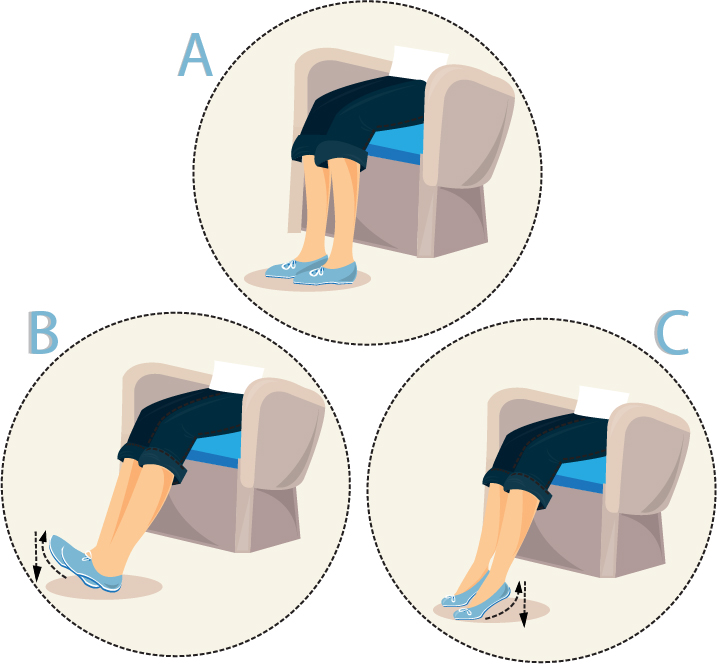
Prolonged sitting, while either waiting in a terminal or in a mode of transportation (e.g. car, train, plane, etc.) is a reality of travelling that can lead to pain and stiffness throughout the body.  The seats often don't provide much support to the low back or neck so you may need to bring or create your own.  You could purchase a lumbar support cushion, use a bunched-up sweater, or roll up a blanket or towel to put in the small of your back.  With respect to your neck, using a travel pillow that fits around your neck will decrease your risk of discomfort while resting or sleeping in a seated position.  Hips and knees can also get quite stiff with extended time spent sitting, particularly in crammed airline seats where you cannot stretch out, and especially if you have pain or arthritis in those joints.  If possible, stand up regularly, every 30-60 minutes, to stretch out and walk around.

In general, moving as much as possible is recommended but even short durations of 10-15 seconds are better than nothing.  Even simple exercises performed while sitting can be quite helpful.  For example, you can raise your heels up and down while keeping your toes on the ground and then lift and lower your toes while keeping your heels down.  You can also tighten and relax the muscles in your legs and if space permits straighten and bend your knees.  The motion will limber you up and promote blood circulation to your tissues.  The improved blood flow also decreases your risk of developing a blood clot in your legs, known as a Deep Vein Thrombosis, which can occur due to prolonged sitting or inactivity and is a significant health concern.

Wearing loose fitting clothing to allow easy movement and staying well hydrated are other suggestions to minimize muscle aches and maximize comfort when travelling.  This article is for general information purposes only and is not to be taken as professional medical advice.

Monday, December 19, 2016

Keeping a Healthy Spine During Holiday Travels

Canadian Chiropractic Association

With the holiday season nearly upon us, many people are gearing up for travels in the next few weeks to visit loved ones or to take a much needed vacation. While time with family and vacations are relaxing and a great way to regenerate energy and zest, the process of traveling itself can often take a toll on our bodies and MSK system.
 
We want you to travel safe, and keep your spine safe too! Take a look at these helpful tips before you jet off this season:
 
Taking Care of Your Posture When Traveling1
 
Carrying luggage, and long flights or road trips can place stress on the lower back which may result in back pain or other musculoskeletal (MSK) conditions. The following tips may assist in keeping your back safe from injury while traveling during the holidays and beyond.
  1. Supporting your lower back. Supporting the curve in the lower back is important. In some cases, airplane seats are worn out and no longer adequately support the lower back leading to the loss of curvature and additional tension on the structures. To avoid sitting for prolonged periods in an “unnatural” position, place a small rolled-up airline pillow, blanket or a towel or lumbar pillow to fit and support the curve of your lower back. Moreover, you may consider sitting in a slightly reclined position to relieve the stress on your spine.
  2. Sit Properly. While seated, your knees should be supported and bent at more or less a 90 degree angle. For example, if your seat is too high, consider placing your feet on something that can act as a firm footrest to keep your knees at a right angle.
  3. Move. Sitting in a static position for extended periods of time can stiffen the back muscles and cause creep in the spine. Movement is key to keeping the spine and MSK system healthy. Get up, stretch and move around every 20 to 30 minutes when possible.
  4. Use proper lifting technique. Use the entire body to turn when lifting heavy luggage. Pivot with your feet, not your back, so that your whole body moves, rather than only twisting your spine.
  5. Don’t make luggage or carry-ons too heavy. Manage what you pack to avoid being left with heavy luggage to carry and maneuver. Lifting excessive weight overhead, for example, can cause hyperextension injuries. Decrease your risk of injury by packing light .
If you’re going to be sitting on a long flight or waiting in airports on long layovers, remember to take time to move, stretch and relieve the stress from travel. Choose lightweight suitcases that are easy to wheel and a properly fitted backpack as your carry on. Making smart choices throughout your travels will help you to enjoy your vacation comfortably once you arrive.
 
1Katherine Teel, “Easy tips from Texas Back Institute to avoid Back Pain while Traveling this Holiday Season,” https://texasback.com/_docs/TBI_Holiday_Travel_Tips_Release.pdf.pdf.

Monday, August 22, 2016

Pain Is A Roadblock To Your Family Vacation

Ontario Chiropractic Association (OCA)


For many families, a road trip is an essential part of any summer vacation.

Unfortunately, muscle and joint pain doesn’t take days off, quickly turning this joyful time into a painful one.
 
Whether you’re lifting heavy luggage or simply sitting in the car for extended periods of time, it’s very common to experience back, neck, shoulder and other joint pain at some point during your travels. Since having fun should be your highest priority, its important to maximize your enjoyment by ensuring that you’re being as safe as you can be.
 
Did you know?

Sitting for long periods of time can be very harmful to your body. Even in the most comfortable cars, certain pressures and forces from awkward positions can result in restricted blood flow.
 
To increase your chances of a pain free trip
  • Choose the right luggage Choosing a bag with wheels and a handle goes a long way to ligthen your load. Alternatively, quality backpacks are a good option as they distribute weight more evenly than other types of luggage.
  • Get comfortableSeat adjustment is critical for avoiding pain on the road. Make sure to adjust the seat to fit you comfortably. If neccesary, roll up a towel or pillow and place it between your lower back and the seat for more support.
  • Bring iceBring a cooler filled with ice packs to help relieve pain on the road. If you need to ice your back, limit it to 15 minutes at a time.
  • Make frequent pit stops
    T
    his gives everyone a chance to stretch and change out of a seated position for a short period of time. Each stop also provides an opportunity to refresh and reduce tension that has been building up in your body.
How to lift your luggage properly
  • Break the action upWhen loading a suitcase into a car or truck, try lifting it onto a chair or step-stool first, rather than doing it all in one motion
  • Use your legsWhen lifting your luggage, first get close to the load and stand with your feet shoulder-width apart
    Bend at the knees and let your leg muscles do the lifting, rather than your back
  • Avoid twistingInstead, turn your feet in the direction you are headed and turn your entire body in that direction.

Wednesday, December 17, 2014

Holiday Health Tips: Ensure Your Holiday Isn’t A Pain In The Neck

Alberta College and Association of Chiropractors


Enjoying your holiday can easily become a painful experience. Here are some helpful tips from Alberta’s chiropractors to ensure your holiday season is full of joy and pain free: 
 
  • If you have to drive more than two hours to visit friends and relatives, take a break - get out of your vehicle and stretch. This temporarily restores normal posture, which will help prevent a recurrence of neck or lower back pain or conditions. 
  • When loading your vehicle for the trip, organize your luggage and packages into smaller loads instead of one large suitcase, cardboard box or carrying case. 
  • Wear your seatbelt and adjust vehicle headrests so that they are no more than two inches behind the centre of the back of the head. Many of the estimated 20 million car accident victims suffering whiplash injuries in North America could have prevented much of the injury had their vehicle seat headrests been adjusted properly.  
  • It’s OK to be a couch potato, but don’t slouch on the sofa and don’t fall asleep on the recliner, as two or three vertebrae in the spine can assume a sharp angle. When you sit up, the normal movement is not restored. Chiropractors often see patients walking into their offices with their heads held sideways, because slouching irritates the nerves and blood vessels, causing muscle spasm.
  • Avoid bending directly over the oven door to lift out the turkey. Crouch down, pull out the oven shelf and use your legs for better balance. This helps reduce the potential of unnecessary strain on the lower spine. 
 
If you experience back, muscle or joint pain, consult a chiropractor. Chiropractors are specialists in back and neck disorders and are specifically trained to diagnose and correct spinal dysfunction.
 
For more information on chiropractic, visit www.nhwc.ca

Tuesday, July 9, 2013

How to Lift Your Luggage

Ontario Chiropractic Association (OCA)

 
In the flurry of packing for a vacation or business trip, it’s easy to get carried away and pack every­thing but the kitchen sink into your suitcase and carry-on. But over-packed luggage and improper lifting and carrying techniques are common causes of injury to the back, neck and shoulders.
 
The good news is many of these injuries can be easily prevented. The following tips can help take the pain out of your vacation:
 
Choosing your luggage:
  • When shopping for new luggage, look for a sturdy, light, high-quality and transportable piece. Avoid purchasing luggage that is too heavy or bulky when empty.
  • Choosing a bag with wheels and a handle can go a long way to lighten your load.
  • A good quality backpack with adjustable, padded shoulder straps and a waist strap makes an ideal carry-on because, when worn properly, backpacks can evenly distribute weight.
Packing your luggage:
  • Over-packing is an easy pitfall, but consider that the larger and heavier the luggage, the more susceptible a traveller is to neck, back and shoulder injuries. Try to only pack what you absolutely need.
  • When possible, place items in a few smaller bags, instead of one large luggage piece.
  • Ensure your carry-on luggage does not weigh more than 10 to 15 per cent of your body weight.
  • Keep the contents of any carry-on luggage to a minimum, pack heavy items at the bottom of the bag and make efficient use of the bag’s pockets.
Lifting and carrying your luggage:
 
Lifting your luggage can’t always be avoided, even if your luggage has wheels. But practising safe lifting techniques can substantially reduce your risk of injury.
  • Move slowly and, whenever possible, break the action into smaller parts. For instance, when loading a suitcase in the trunk of a car, try lifting it first onto a chair or step-stool, then lifting it into the trunk. Similarly, when placing luggage in an overhead com­partment, first lift it onto the top of the seat.
  • When lifting your luggage, first get close to the load and stand with your feet shoulder-width apart.
  • Bend at the knees and let your leg muscles, rather than your back, do the lifting.
  • Hold the load close to your body.
  • Avoid twisting. Instead, turn your feet in the direction you are headed and turn your entire body in that direction.
  • Do not carry bulky luggage for long peri­ods of time. Make sure to check heavier items when travelling rather than carrying them for the duration of the trip.
  • Try to carry light pieces in each hand rather than a single heavy item on one side.
  • If using a backpack, use both shoulder straps and the waist strap, and adjust them to minimize the bag’s movement.
  • If using a duffel or shoulder bag, switch sides often to reduce strain.