Showing posts with label proper lifting. Show all posts

Friday, May 31, 2019

Safe Gardening Tips To Prevent Injury


By Dr. John A. Papa, DC, FCCPOR(C)

Spring is upon us and so is the arrival of the gardening season.  Raking, lifting, digging, and planting can be strenuous activities.  Below are some simple tips that can help you avoid and prevent injury during the gardening season.

1.    Prepare your body for physical activity with a warm-up.  Climbing stairs, marching on the spot, or going for a quick walk around the block are examples of excellent warm-up activities that can completed in as little as five to ten minutes.  Follow this with some gentle stretch exercises such as knee to chest, shoulder, forearm and wrist stretches.  Your muscles and joints will appreciate this prior to being asked to do work.

2.   Use the right tools for the tasks to be performed.  Always make sure that tools are a comfortable weight and size for you.  There are many ergonomically designed tools which are lightweight, with long padded handles and spring action mechanisms that can reduce strain and effort.  Carts and wheelbarrows minimize the need for lifting and carrying, reducing your risk of physical injury.

3.  Proper lifting means bend the knees, keep the back straight and brace!  Use your leg and arm muscles to do the lifting while keeping your back straight.  Maintaining the natural and neutral curves of your back is important, as this is its strongest and most secure position.  Contracting and bracing your abdominal muscles during lifting improves spinal stability and decreases the chance of injury.  Avoid twisting and turning by positioning yourself accordingly.  Be sure to lift slowly and smoothly with the load close to your body and do not jerk with your lifts.

4.   Alternate activities and change positions.  Once you begin, take turns alternating between heavy chores such as digging, and lighter less physically demanding tasks such as planting, every 10 to 15 minutes.  Avoid prolonged working postures.  Changing hands frequently when you rake, hoe or dig prevents muscle strain and joint stress on one side of the body.

5.   Drink plenty of water before, during and after gardening activity.  Dehydration affects your energy level and physical functioning.  Staying hydrated decreases the risks of cramps and strains, and helps to protect joints by providing lubrication and cushioning.

6.  Preparing for the elements and pacing.  Select comfortable, thick-soled, protective shoes that support your arches to reduce joint pain and aching muscles.  To protect from sun exposure, apply sunscreen, and wear a wide-brim hat.  Wear loose and comfortable clothing.  Work at a safe pace and know your physical limits.  Stop gardening immediately if you feel chest pain or persistent muscle or joint pain.

In the event that you suffer a muscle or joint injury while gardening that does not subside, you should contact a licensed health professional who deals in the diagnosis and treatment of these injuries.  For more information, visit www.nhwc.ca.

This article is a basic summary for educational purposes only.  It is not intended, and should not be considered, as a replacement for consultation, diagnosis or treatment by a duly licensed health practitioner.

Wednesday, December 27, 2017

Protecting Your Back During The Winter Season

By Dr. John A. Papa, DC, FCCPOR(C)
 
The winter season is upon us and extra precaution must be taken as snow removal and icy walking surfaces can contribute to an increased risk of back injuries.  Included below are some useful tips that can be followed to help keep your back healthy and injury free this winter season.
 
1.    Warm up:  Prepare your body for physical activity by stimulating the joints and muscles, and increasing blood circulation.  Climbing stairs, marching on the spot, or going for a quick walk around the block can serve as excellent warm-up activities in five to ten minutes.  Follow this with some gentle stretches and exercises for the back.
 
2.    Push, don’t lift:  Push the snow to one side and avoid lifting.  If you must lift, keep the shovel close to your body and avoid twisting and turning by positioning yourself to lift and throw straight at the snow pile.  Be sure to lift slowly and smoothly and do not jerk with your lifts.
 
3.    Hinge the hips, bend the knees, keep the back straight and brace:  Use your hips, knees, legs and arm muscles to do the pushing and lifting while keeping your back straight.  Maintaining the natural and neutral curves of your back is important, as this is its strongest and most secure position.  Contracting and bracing your abdominal muscles during lifting improves spinal stability and decreases the chance of injury.
 
4.    Use the right shovel:  Use a lightweight, non-stick, push-style shovel.  Separate your hands as much as possible on the shovel handle for better leverage against the weight of the snow.
 
5.    Dress for the job:  Wear warm clothing to protect yourself against the elements.  Shoes and boots with solid treads and soles can help minimize the risk of awkward twisting, slips and falls.
 
6.    Don’t let the snow pile up:  Removing small amounts of snow on a frequent basis is less strenuous in the long run.
 
7.    Watch the ice:  Caution should be exercised around icy walkways and slippery surfaces.  Intermittent thaws and subsequent freezing can give way to ice build-up under foot increasing the risk of back twisting, slips and falls.  Coarse sand or ice salt can help give your walkways and driveways more traction.
 
8.    Take a break:  Know your physical limits.  If you feel tired or short of breath, stop and take a rest.  Make a habit to rest for a moment every 10 or 15 minutes during shoveling.  This is especially important if the snow is wet and heavy.  Stop shoveling immediately if you feel chest or back pain.
 
In the event that you suffer a back injury that does not subside, you should contact a licensed health professional who deals in the diagnosis and treatment of back pain.  For more information, visit www.nhwc.ca.
 
This article is a basic summary for educational purposes only.  It is not intended, and should not be considered, as a replacement for consultation, diagnosis or treatment by a duly licensed health practitioner.

Saturday, December 23, 2017

Happy Holidays!

Canadian Chiropractic Association


It’s the time of year for family and friends, food and good cheer. However, for a lot of people, the season can be hectic, stressful and exhausting. Your to-do list may be long, and you may feel anxious about completing it in time. But, are you taking care of yourself while you hurtle around preparing for the Season? Canada’s chiropractors want you to have a joyful holiday, so we’ve put together a few tips that we hope will help keep you healthy and happy throughout this busy season.
 

Lift Right

The holidays usually involve lifting and lugging scads of groceries and parcels. If possible, ask a friend or family member to help you carry on your merry cheer! If no one is available, consider making several trips and carrying smaller loads to prevent the risk of injury. Also, visit our Lift Right page for tips on how to prevent injury while lifting.
 

Take a Break

Do you enjoy entertaining during the holidays? Carolers at the door, a house full of people, children running around? That can involve a lot of cooking and cleaning, decorating and preparations. Make sure to take frequent breaks and keep hydrated. Set a timer every hour or so, have a glass of water and sit for a few minutes. For tips on getting a good night’s sleep, browse through our Good Night’s Sleep page.
 

Ask for Help

Being present and enjoying the company of your friends and family is what is of utmost importance. Even during the holidays, no one expects you to be a super-human. Excessive expectations and stress can heighten your risk for injury and illness. Instead, ask your friends and family for help and everyone will be merrier for it! You can also read about some useful Energy Boosters here.
 

Stay Active

The holidays are a time when we are surrounded by temptations. One key strategy to manage and cope is to keep moving and stay active! Winter offers a multitude of fun family activities including skating in the park or a brisk trek around the block. Activity will keep you energized during the day and help you sleep at night. Before you hit the ice or go tobogganing, make sure you warm up first! Here are some great stretches for hockey and running.
 

Drink Responsibly

Trips, slips and falls account for many injuries in the winter months. However, drinking can also add to the risk of falls. Moderation is the key! Here are some good strategies from the Canadian Centre for Substance Abuse.
  • Set limits for yourself and stick to them.
  • Drink slowly.
  • Have no more than 2 drinks in any 3 hours.
  • For every drink of alcohol, have one non-alcoholic drink.
  • Eat before and while you are drinking.
  • Always consider your age, body weight and health problems that might suggest lower limits.


Here’s to safe, healthy and happy holidays for all Canadians!

Monday, February 13, 2017

Managing Muscle & Joint Pain While Travelling

By Dr. R. Greg Lusk, DC

Along with the weather, winter get-away travel plans are a common topic of conversation this time of year while making small talk with clients.  Upcoming travel is also a driving force for some to have a painful complaint checked out as they are dreading the travel process ahead and are hopeful that the pain can be lessened so they can enjoy the vacation as originally planned.  Even for those that book an initial appointment a mere few days before departure, which doesn't allow much time for treatment to yield results, learning some key things to keep in mind or do while travelling can empower them to manage their symptoms independently.

Let's start with luggage as managing a heavy suitcase can be difficult even when you're not in pain.  Try to be restrictive in what you pack to lessen the overall weight and consider multiple bags versus a single large and heavy one if you cannot pack light.  Use wheels and pull handles if available.  Lift luggage with a straight back, bend at your hips and knees, and avoid twisting through the spine.  Lifting in stages can also help avoid excessive strain.  For example, when lifting a bag into an overhead bin, it can first be lifted to the top of the seat and then into the bin in a separate action. Similarly, loading a suitcase in or out of the trunk can be broken into steps, such that you lift the bag onto the bumper or edge of the trunk and then into the actual trunk.

Prolonged sitting, while either waiting in a terminal or in a mode of transportation (e.g. car, train, plane, etc.) is a reality of travelling that can lead to pain and stiffness throughout the body.  The seats often don't provide much support to the low back or neck so you may need to bring or create your own.  You could purchase a lumbar support cushion, use a bunched-up sweater, or roll up a blanket or towel to put in the small of your back.  With respect to your neck, using a travel pillow that fits around your neck will decrease your risk of discomfort while resting or sleeping in a seated position.  Hips and knees can also get quite stiff with extended time spent sitting, particularly in crammed airline seats where you cannot stretch out, and especially if you have pain or arthritis in those joints.  If possible, stand up regularly, every 30-60 minutes, to stretch out and walk around.

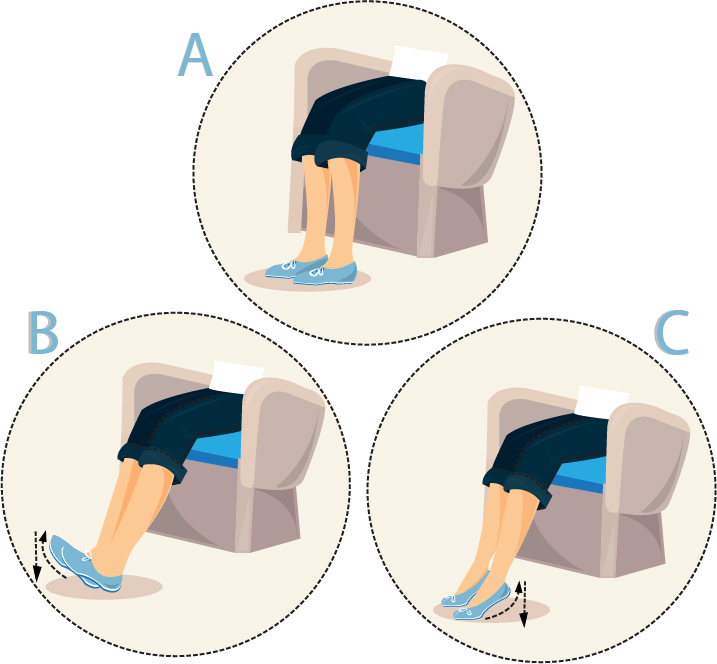
In general, moving as much as possible is recommended but even short durations of 10-15 seconds are better than nothing.  Even simple exercises performed while sitting can be quite helpful.  For example, you can raise your heels up and down while keeping your toes on the ground and then lift and lower your toes while keeping your heels down.  You can also tighten and relax the muscles in your legs and if space permits straighten and bend your knees.  The motion will limber you up and promote blood circulation to your tissues.  The improved blood flow also decreases your risk of developing a blood clot in your legs, known as a Deep Vein Thrombosis, which can occur due to prolonged sitting or inactivity and is a significant health concern.

Wearing loose fitting clothing to allow easy movement and staying well hydrated are other suggestions to minimize muscle aches and maximize comfort when travelling.  This article is for general information purposes only and is not to be taken as professional medical advice.

Monday, January 30, 2017

Your Whole World Is On Your Shoulders

Ontario Chiropractic Association

A study in the Journal of Orthopaedics reported that 50-90% of pregnant women will likely experience lower back pain. This pain may persist after giving birth if you don’t take action.


Keep your back healthy at home
Here are some ways to reduce the risk of back and neck pain:
  • Lighten your load
    Choose a diaper bag that distributes weight evenly across your body to limit the stress of isolated muscles.
  • Stretch your body
    While your baby is old enough for tummy time, join them on the floor and do some exercises to stretch your neck and back.
  • Feed comfortably
    When nursing, avoid hunching and keep your baby close to you. Also choose a comfortable, upright chair with a pillow.
  • Keep your baby close
    Don’t stretch your arms out – bring your baby close to your chest before lifting. Consider wearing your baby on your front so you can alleviate the strain on your back.
  • Keep tub trouble at bay
    Avoid reaching or twisting when bending over a tub. When kneeling, use a non-slip mat to protect your knees.

Exercises/stretches to help alleviate your back pain at home:
  • Shoulder opener
    Breathing deeply and calmly, relax your stomach muscles
    Let your head hang loosely forward and gently roll from side to side
    Bring your hands up to your neck and gently massage the back of your head and neck
    Drop your arms to your sides, relax your shoulders & slowly roll them backward and forward for 15 seconds
  • Crossover
    Standing with feet shoulder width apart, raise your hands
    Bring your right elbow across your body while lifting your left knee
    Touch elbow to knee, remaining upright and repeat alternating sides for 15 seconds

For more information on Chiropractic Care, visit http://nhwc.ca/nhwc_chiropractic.html

Thursday, December 22, 2016

Protecting Your Back During The Winter Season

By Dr. John A. Papa, DC, FCCPOR(C)

The winter season is upon us and extra precaution must be taken as snow removal and icy walking surfaces can contribute to an increased risk of back injuries.  Included below are some useful tips that can be followed to help keep your back healthy and injury free this winter season.
 
1.    Warm up:  Prepare your body for physical activity by stimulating the joints and muscles, and increasing blood circulation.  Climbing stairs, marching on the spot, or going for a quick walk around the block can serve as excellent warm-up activities in five to ten minutes.  Follow this with some gentle stretches and exercises for the back.
 
2.    Push, don’t lift:  Push the snow to one side and avoid lifting.  If you must lift, keep the shovel close to your body and avoid twisting and turning by positioning yourself to lift and throw straight at the snow pile.  Be sure to lift slowly and smoothly and do not jerk with your lifts.
 
3.    Hinge the hips, bend the knees, keep the back straight and brace:  Use your hips, knees, legs and arm muscles to do the pushing and lifting while keeping your back straight.  Maintaining the natural and neutral curves of your back is important, as this is its strongest and most secure position.  Contracting and bracing your abdominal muscles during lifting improves spinal stability and decreases the chance of injury.
 
4.    Use the right shovel:  Use a lightweight, non-stick, push-style shovel.  Separate your hands as much as possible on the shovel handle for better leverage against the weight of the snow.
 
5.    Dress for the job:  Wear warm clothing to protect yourself against the elements.  Shoes and boots with solid treads and soles can help minimize the risk of awkward twisting, slips and falls.
 
6.    Don’t let the snow pile up:  Removing small amounts of snow on a frequent basis is less strenuous in the long run.
 
7.    Watch the ice:  Caution should be exercised around icy walkways and slippery surfaces.  Intermittent thaws and subsequent freezing can give way to ice build-up under foot increasing the risk of back twisting, slips and falls.  Coarse sand or ice salt can help give your walkways and driveways more traction.
 
8.    Take a break:  Know your physical limits.  If you feel tired or short of breath, stop and take a rest.  Make a habit to rest for a moment every 10 or 15 minutes during shoveling.  This is especially important if the snow is wet and heavy.  Stop shoveling immediately if you feel chest or back pain.
 
In the event that you suffer a back injury that does not subside, you should contact a licensed health professional who deals in the diagnosis and treatment of back pain.  For more information, visit www.nhwc.ca.

This article is a basic summary for educational purposes only.  It is not intended, and should not be considered, as a replacement for consultation, diagnosis or treatment by a duly licensed health practitioner.

Monday, December 19, 2016

Keeping a Healthy Spine During Holiday Travels

Canadian Chiropractic Association

With the holiday season nearly upon us, many people are gearing up for travels in the next few weeks to visit loved ones or to take a much needed vacation. While time with family and vacations are relaxing and a great way to regenerate energy and zest, the process of traveling itself can often take a toll on our bodies and MSK system.
 
We want you to travel safe, and keep your spine safe too! Take a look at these helpful tips before you jet off this season:
 
Taking Care of Your Posture When Traveling1
 
Carrying luggage, and long flights or road trips can place stress on the lower back which may result in back pain or other musculoskeletal (MSK) conditions. The following tips may assist in keeping your back safe from injury while traveling during the holidays and beyond.
  1. Supporting your lower back. Supporting the curve in the lower back is important. In some cases, airplane seats are worn out and no longer adequately support the lower back leading to the loss of curvature and additional tension on the structures. To avoid sitting for prolonged periods in an “unnatural” position, place a small rolled-up airline pillow, blanket or a towel or lumbar pillow to fit and support the curve of your lower back. Moreover, you may consider sitting in a slightly reclined position to relieve the stress on your spine.
  2. Sit Properly. While seated, your knees should be supported and bent at more or less a 90 degree angle. For example, if your seat is too high, consider placing your feet on something that can act as a firm footrest to keep your knees at a right angle.
  3. Move. Sitting in a static position for extended periods of time can stiffen the back muscles and cause creep in the spine. Movement is key to keeping the spine and MSK system healthy. Get up, stretch and move around every 20 to 30 minutes when possible.
  4. Use proper lifting technique. Use the entire body to turn when lifting heavy luggage. Pivot with your feet, not your back, so that your whole body moves, rather than only twisting your spine.
  5. Don’t make luggage or carry-ons too heavy. Manage what you pack to avoid being left with heavy luggage to carry and maneuver. Lifting excessive weight overhead, for example, can cause hyperextension injuries. Decrease your risk of injury by packing light .
If you’re going to be sitting on a long flight or waiting in airports on long layovers, remember to take time to move, stretch and relieve the stress from travel. Choose lightweight suitcases that are easy to wheel and a properly fitted backpack as your carry on. Making smart choices throughout your travels will help you to enjoy your vacation comfortably once you arrive.
 
1Katherine Teel, “Easy tips from Texas Back Institute to avoid Back Pain while Traveling this Holiday Season,” https://texasback.com/_docs/TBI_Holiday_Travel_Tips_Release.pdf.pdf.

Wednesday, April 15, 2015

Gardening Advice to Prevent Injury

By Dr. Greg Lusk, DC


After a colder than average February, reminiscent of my formative years in Timmins, Ontario, I think we'd all agree that it's time to move life outside!
 
For those new to gardening it may hardly seem like a demanding activity; however, seasoned veterans know there’s plenty of hard work involved.  Raking, lifting, hauling, digging, aerating, and planting are all good exercise, but they can also lead to injury if the gardener isn’t prepared.  If fact, 88% of Ontario's chiropractors report that gardening is the most common source of back and neck pain during the warm weather season.  Like any new activity that hasn't been performed in a while, your body needs to be gradually re-conditioned to the demands.
 
Improper gardening techniques may cause repetitive strain injuries of the wrist and elbow, sprain/strain injuries to muscles throughout the body, especially in the lower back, and general wear and tear on joints and muscles.  Here are a few tips to stay pain free:

 
1.    Warm up.  Take a short walk around the block or climb up and down the stairs a few times.  The goal is to elevate your body temperature and increase your circulation.  You can also do some leg, spine, shoulder and forearm range of motion stretches to get those areas ready for activity.  Your muscles and joints will appreciate this prior to being asked to do work.
 
2.    Alternate tasks and change positions.  Switch between heavier tasks such as digging and raking and lighter tasks such as planting every 10 to 15 minutes.  The change of body position with each different activity allows you to recover and avoid fatigue.  Changing hands when raking or digging also helps to share the load on both sides of the body.
 
3.    Have the right tools.  An ergonomically designed tool with padded handles and spring action features can decrease the stress on your body.  Make sure they are the right size and weight for you.  Carts and wheelbarrows minimize the need for lifting and carrying, reducing your risk of injury.
 
4.    Do the "scissors" when you rake.  Stand with your legs in a split stance and alternate which leg is forward every few minutes.  This will decrease the strain on your back.
 
5.    Kneel to plant and weed.  Constant bending strains your back, neck, and legs.  Use knee pads for comfort and keep your back straight.
 
6.    Lift correctly.  Bend your knees, feet shoulder width apart, keep the back straight/"neutral", and tighten your core.  Keep the load close to your body.  Pivot at your hips and ankles if you need to change directions and avoid twisting your spine.  Share the load if it is heavy.
 
7.    Take frequent breaks.  Three brief breaks each hour is recommended.  Have a drink, stretch, or sit and relax.  Life is busy but you don't want to make this a race.  Spread the work out over a few days.
 
8.    Dress correctly and hydrate.  Your feet should be protected with thick-soled supportive shoes.  This will avoid direct injury to the feet and best support your body to minimize back pain and muscular strain.  Wear loose fitting, comfortable clothing to not restrict your flexibility.  Also drink plenty of water to keep your muscles and joints moving freely.
 
Stop gardening if you experience persistent muscle and/or joint pain.  If you experience back pain that lasts more than two to three days, contact a licensed health professional for an evaluation.  This article is for general information purposes only and is not to be taken as professional medical advice.

Wednesday, June 4, 2014

Safe Gardening Tips To Prevent Injury

By:  Dr. John A. Papa, DC, FCCPOR(C)

Spring is upon us and so is the arrival of the gardening season.  Raking, lifting, digging, and planting can be strenuous activities.  Below are some simple rules and precautions that can be followed to help avoid and prevent injury during the gardening season.
  
1.    Warm up:  Prepare your body for physical activity by stimulating the joints and muscles, and increasing blood circulation.  Climbing stairs, marching on the spot, or going for a quick walk around the block can serve as excellent warm ups in five to ten minutes.  Follow this with some gentle stretch exercises such as knee to chest, forearm and wrist stretches.
 
2.    Use the right tools:  Make sure you select the correct tool for the task to be performed.  Always make sure that tools are a comfortable weight and size for you.  There are many ergonomically designed tools, which are lightweight with long padded handles and spring action mechanisms that can reduce strain and effort.
 
3.    Proper lifting means bend the knees, keep the back straight and brace!  Use your leg and arm muscles to do the lifting while keeping your back straight.  Maintaining the natural and neutral curves of your back is important, as this is its strongest and most secure position.  Contracting and bracing your abdominal muscles during lifting improves spinal stability and decreases the chance of injury.  Avoid twisting and turning by positioning yourself accordingly.  Be sure to lift slowly and smoothly with the load close to your body and do not jerk with your lifts.
 
4.    Alternate activities and change positions:  Once you begin, take turns alternating between heavy chores such as digging, and lighter less physically demanding tasks such as planting, every 10 to 15 minutes.  Avoid prolonged working postures.  Changing hands frequently when you rake, hoe or dig prevents muscle strain and joint stress on one side of the body.
  
5.    Preparing for the elements and pacing:  Select comfortable, thick-soled, protective shoes that support your arches to reduce back pain and aching muscles.  To protect from sun exposure, apply sunscreen, wear a wide-brim hat and drink plenty of water.  Wear loose and comfortable clothing. Know your physical limits. Stop gardening immediately if you feel chest pain or persistent back or joint pain.
  
In the event that you suffer a back, neck, or joint injury while gardening that does not subside, you should contact a licensed health professional who deals in the diagnosis and treatment of muscle and joint pain.  For more information, visit www.nhwc.ca.
 
This article is a basic summary for educational purposes only.  It is not intended, and should not be considered, as a replacement for consultation, diagnosis or treatment by a duly licensed health practitioner.

Tuesday, July 9, 2013

How to Lift Your Luggage

Ontario Chiropractic Association (OCA)

 
In the flurry of packing for a vacation or business trip, it’s easy to get carried away and pack every­thing but the kitchen sink into your suitcase and carry-on. But over-packed luggage and improper lifting and carrying techniques are common causes of injury to the back, neck and shoulders.
 
The good news is many of these injuries can be easily prevented. The following tips can help take the pain out of your vacation:
 
Choosing your luggage:
  • When shopping for new luggage, look for a sturdy, light, high-quality and transportable piece. Avoid purchasing luggage that is too heavy or bulky when empty.
  • Choosing a bag with wheels and a handle can go a long way to lighten your load.
  • A good quality backpack with adjustable, padded shoulder straps and a waist strap makes an ideal carry-on because, when worn properly, backpacks can evenly distribute weight.
Packing your luggage:
  • Over-packing is an easy pitfall, but consider that the larger and heavier the luggage, the more susceptible a traveller is to neck, back and shoulder injuries. Try to only pack what you absolutely need.
  • When possible, place items in a few smaller bags, instead of one large luggage piece.
  • Ensure your carry-on luggage does not weigh more than 10 to 15 per cent of your body weight.
  • Keep the contents of any carry-on luggage to a minimum, pack heavy items at the bottom of the bag and make efficient use of the bag’s pockets.
Lifting and carrying your luggage:
 
Lifting your luggage can’t always be avoided, even if your luggage has wheels. But practising safe lifting techniques can substantially reduce your risk of injury.
  • Move slowly and, whenever possible, break the action into smaller parts. For instance, when loading a suitcase in the trunk of a car, try lifting it first onto a chair or step-stool, then lifting it into the trunk. Similarly, when placing luggage in an overhead com­partment, first lift it onto the top of the seat.
  • When lifting your luggage, first get close to the load and stand with your feet shoulder-width apart.
  • Bend at the knees and let your leg muscles, rather than your back, do the lifting.
  • Hold the load close to your body.
  • Avoid twisting. Instead, turn your feet in the direction you are headed and turn your entire body in that direction.
  • Do not carry bulky luggage for long peri­ods of time. Make sure to check heavier items when travelling rather than carrying them for the duration of the trip.
  • Try to carry light pieces in each hand rather than a single heavy item on one side.
  • If using a backpack, use both shoulder straps and the waist strap, and adjust them to minimize the bag’s movement.
  • If using a duffel or shoulder bag, switch sides often to reduce strain.