Showing posts with label hydration. Show all posts

Monday, September 10, 2018

Fitness Tips For Recreational Athletes


By Dr. John A. Papa, DC, FCCPOR(C)


Physical activity is an important part of a healthy lifestyle.  Being active can help you maintain a healthy weight, reduce blood pressure, build strong bones, relieve stress, and maintain flexibility and good posture.  Included below are some tips to help you protect your body and prevent injury so that you can get the most from your favourite activity this summer season.

1.    Warm-up and cool-down both before and after your game.  Include gentle stretching and range of motion exercises, as well as a brisk walk or gentle jog to loosen the muscles and joints.

2. Improve your performance by including flexibility and strengthening exercises as part of your training and practice routine. Muscles act as important shock absorbers and help prevent strains and sprains of vulnerable regions such as the back and neck, along with the shoulder, elbow, wrist, hip, knee, and ankle joints.

3.    Nourish your body by staying hydrated.  Drink plenty of fluids before, during and after physical activity - even in colder weather.  Remember that once you are thirsty, you are already starting to dehydrate.  Dehydration affects your energy level and your physical functioning.

4.    Prepare for the elements.  Avoid sunburn which is a result of overexposure to the sun’s UV radiation and can contribute to certain skin cancers, and a premature aging and wrinkling of the skin.  To protect from sun exposure, apply sunscreen and wear a wide-brim hat and light-colored clothing that covers your exposed skin.  Your eyes should also be protected with UV blocking sunglasses.  Outdoor activities and sports should be limited to the early morning or late afternoon when UV rays are not as strong.  Be cautious on cloudy days, as your skin is still susceptible to burn under these conditions.

5.  Learn the proper technique.  Learn the right technique for your sport from the beginning.  Using the wrong sport-specific technique can create incorrect muscle memory and can make it difficult to break bad habits.  Poor technique can also cause injury to your joints and muscles.

6.    Use the right equipment.  Make sure your equipment is the right fit, height and capacity for you to avoid a sport-related injury.  Recreational athletes should have their equipment professionally fitted and checked before starting out.

7.    Avoid over-training.  Too much.  Too fast.  Too soon.  Over-training is one of the most common causes of recreational athletic injuries.  Take your time and work up to it slowly before pushing yourself too hard.  Remember – rest is as important as training.  Take a training break and give your body a chance to recover.

In the event that you suffer a muscle or joint injury that does not subside, you should contact a licensed health professional.  For more information, visit www.nhwc.ca.  The author credits the Canadian Chiropractic Association (CCA) in the preparation of this educational information for use by its members and the public.

This article is a basic summary for educational purposes only.  It is not intended, and should not be considered, as a replacement for consultation, diagnosis or treatment by a duly licensed health practitioner.

Monday, October 16, 2017

Injury Prevention Tips For Hockey Players


By Dr. John A. Papa, DC, FCCPOR(C)

Hockey is a popular recreational sport enjoyed by individual's of all ages and abilities.  Due to the high speed and aggressive play involved, hockey can put players at risk for injury.  Although sticks, pucks, and skate blades can do damage, most hockey-related injuries occur due to collisions with other players and the boards.  Fatigue and low energy of participants due to poor endurance, insufficient rest, or too much ice time can also make them more likely to get hurt.

Most hockey injuries involve the upper body, and can include fractures, sprains and strains of the collarbones, hands, arms, and shoulders.  Low back, groin, hip, knee, and ankle injuries also occur frequently.  Concussions are the most common type of head injury and are often accompanied by neck injury/pain.

Included below are some tips to help hockey players avoid and/or minimize the chances of muscle and joint injuries.

1.    Proper training is important.  A good training program should involve cardiovascular, stretching, and strengthening exercises.
  • Cardiovascular training will increase endurance and decrease fatigue, which has been linked to injuries.
  • A comprehensive stretching program for the back, arms, shoulders, thighs, and legs should be performed both before and after games to keep muscles limber and prevent stiffness and soreness.
  • Strengthening programs improve a muscle’s ability to contract and perform joint movement.  Muscles also act as important shock absorbers and help prevent sprains and strains of vulnerable regions such as the back and neck, along with the shoulder, hip and groin regions.

2.    Get enough rest and hydration.  Since fatigue is one of the most common causes of injury, even the fittest players should often take breaks to rest.  Dehydration affects your energy level and your physical functioning.  Drink plenty of fluids before, during, and after play.

3.    Use the right equipment.  Properly fitting gear can make a world of difference when it comes to avoiding injury.  Replace worn out equipment.  Helmets have a life span of three to five years, depending on how often they are used.  Helmets with face shields have been proven to reduce the severity of concussions regardless of the player's experience level and position when compared to visors alone.

4.    Respect the rules.  Promote sportsmanship and fair play.  Support a zero tolerance rule for illegal checks and maneuvers.

5.    Take care of injuries before returning to play.  This will ensure top physical functioning and help prevent further injury and chronic pain.

Chiropractors are healthcare professionals skilled in the diagnosis and treatment of hockey-related injuries.  In the event that you suffer a muscle or joint injury while playing hockey that does not subside,  consider chiropractic care.  For more information, visit www.nhwc.ca.  The author credits the Ontario Chiropractic Association (OCA) in the preparation of this educational information for use by its members and the public.

This article is a basic summary for educational purposes only.  It is not intended, and should not be considered, as a replacement for consultation, diagnosis or treatment by a duly licensed health practitioner.

Tuesday, September 5, 2017

Fitness Tips For Recreational Athletes

By Dr. John A. Papa, DC, FCCPOR(C)

Physical activity is an important part of a healthy lifestyle.  Being active can help you maintain a healthy weight, reduce blood pressure, build strong bones, relieve stress, and maintain flexibility and good posture.  Included below are some tips to help you protect your body and prevent injury so that you can get the most from your favourite activity this summer season.

1.    Warm-up and cool-down both before and after your game.  Include gentle stretching and range of motion exercises, as well as a brisk walk or gentle jog to loosen the muscles and joints.

2.    Improve your performance by including flexibility and strengthening exercises as part of your training and practice routine.  Muscles act as important shock absorbers and help prevent strains and sprains of vulnerable regions such as the back and neck, along with the shoulder, elbow, wrist, hip, knee, and ankle joints.

3.    Nourish your body by staying hydrated.  Drink plenty of fluids before, during and after physical activity - even in colder weather.  Remember that once you are thirsty, you are already starting to dehydrate.  Dehydration affects your energy level and your physical functioning.

4.    Prepare for the elements.  Avoid sunburn which is a result of overexposure to the sun’s UV radiation and can contribute to certain skin cancers, and a premature aging and wrinkling of the skin.  To protect from sun exposure, apply sunscreen and wear a wide-brim hat and light-colored clothing that covers your exposed skin.  Your eyes should also be protected with UV blocking sunglasses.  Outdoor activities and sports should be limited to the early morning or late afternoon when UV rays are not as strong.  Be cautious on cloudy days, as your skin is still susceptible to burn under these conditions.

5.    Learn the proper technique.  Learn the right technique for your sport from the beginning.  Using the wrong sport-specific technique can create incorrect muscle memory and can make it difficult to break bad habits.  Poor technique can also cause injury to your joints and muscles.

6.    Use the right equipment.  Make sure your equipment is the right fit, height and capacity for you to avoid a sport-related injury.  Recreational athletes should have their equipment professionally fitted and checked before starting out.

7.    Avoid over-training.  Too much.  Too fast.  Too soon.  Over-training is one of the most common causes of recreational athletic injuries.  Take your time and work up to it slowly before pushing yourself too hard.  Remember – rest is as important as training.  Take a training break and give your body a chance to recover.

In the event that you suffer a muscle or joint injury that does not subside, you should contact a licensed health professional.  For more information, visit www.nhwc.ca.  The author credits the Canadian Chiropractic Association (CCA) in the preparation of this educational information for use by its members and the public.

This article is a basic summary for educational purposes only.  It is not intended, and should not be considered, as a replacement for consultation, diagnosis or treatment by a duly licensed health practitioner.

Monday, February 13, 2017

Managing Muscle & Joint Pain While Travelling

By Dr. R. Greg Lusk, DC

Along with the weather, winter get-away travel plans are a common topic of conversation this time of year while making small talk with clients.  Upcoming travel is also a driving force for some to have a painful complaint checked out as they are dreading the travel process ahead and are hopeful that the pain can be lessened so they can enjoy the vacation as originally planned.  Even for those that book an initial appointment a mere few days before departure, which doesn't allow much time for treatment to yield results, learning some key things to keep in mind or do while travelling can empower them to manage their symptoms independently.

Let's start with luggage as managing a heavy suitcase can be difficult even when you're not in pain.  Try to be restrictive in what you pack to lessen the overall weight and consider multiple bags versus a single large and heavy one if you cannot pack light.  Use wheels and pull handles if available.  Lift luggage with a straight back, bend at your hips and knees, and avoid twisting through the spine.  Lifting in stages can also help avoid excessive strain.  For example, when lifting a bag into an overhead bin, it can first be lifted to the top of the seat and then into the bin in a separate action. Similarly, loading a suitcase in or out of the trunk can be broken into steps, such that you lift the bag onto the bumper or edge of the trunk and then into the actual trunk.

Prolonged sitting, while either waiting in a terminal or in a mode of transportation (e.g. car, train, plane, etc.) is a reality of travelling that can lead to pain and stiffness throughout the body.  The seats often don't provide much support to the low back or neck so you may need to bring or create your own.  You could purchase a lumbar support cushion, use a bunched-up sweater, or roll up a blanket or towel to put in the small of your back.  With respect to your neck, using a travel pillow that fits around your neck will decrease your risk of discomfort while resting or sleeping in a seated position.  Hips and knees can also get quite stiff with extended time spent sitting, particularly in crammed airline seats where you cannot stretch out, and especially if you have pain or arthritis in those joints.  If possible, stand up regularly, every 30-60 minutes, to stretch out and walk around.

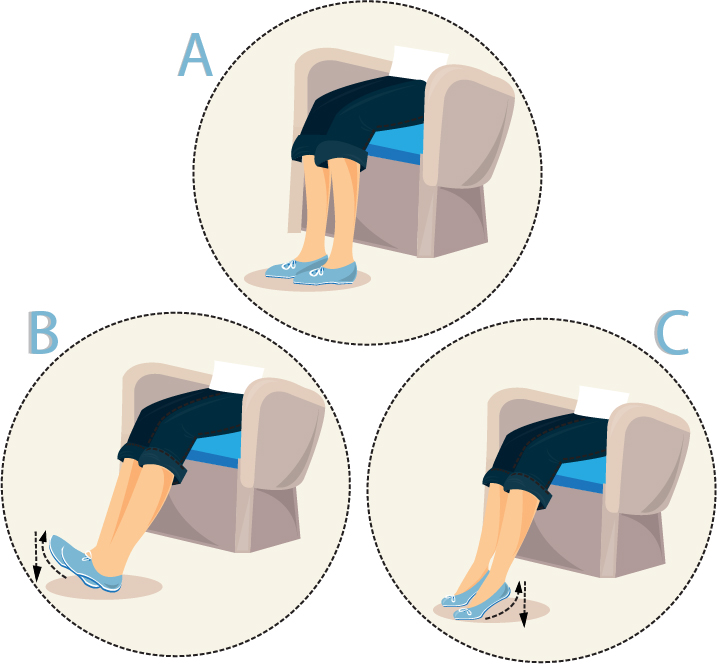
In general, moving as much as possible is recommended but even short durations of 10-15 seconds are better than nothing.  Even simple exercises performed while sitting can be quite helpful.  For example, you can raise your heels up and down while keeping your toes on the ground and then lift and lower your toes while keeping your heels down.  You can also tighten and relax the muscles in your legs and if space permits straighten and bend your knees.  The motion will limber you up and promote blood circulation to your tissues.  The improved blood flow also decreases your risk of developing a blood clot in your legs, known as a Deep Vein Thrombosis, which can occur due to prolonged sitting or inactivity and is a significant health concern.

Wearing loose fitting clothing to allow easy movement and staying well hydrated are other suggestions to minimize muscle aches and maximize comfort when travelling.  This article is for general information purposes only and is not to be taken as professional medical advice.

Wednesday, October 19, 2016

Injury Prevention Tips For Hockey Players

By Dr. John A. Papa, DC, FCCPOR(C)

Hockey is a popular recreational sport enjoyed by individual's of all ages and abilities.  Due to the high speed and aggressive play involved, hockey can put players at risk for injury.  Although sticks, pucks, and skate blades can do damage, most hockey-related injuries occur due to collisions with other players and the boards.  Fatigue and low energy of participants due to poor endurance, insufficient rest, or too much ice time can also make them more likely to get hurt.

Most hockey injuries involve the upper body, and can include fractures, sprains and strains of the collarbones, hands, arms, and shoulders.  Low back, groin, hip, knee, and ankle injuries also occur frequently.  Concussions are the most common type of head injury and are often accompanied by neck injury/pain.

Included below are some tips to help hockey players avoid and/or minimize the chances of muscle and joint injuries.

1.    Proper training is important.  A good training program should involve cardiovascular, stretching, and strengthening exercises.

  • Cardiovascular training will increase endurance and decrease fatigue, which has been linked to injuries.
  • A comprehensive stretching program for the back, arms, shoulders, thighs, and legs should be performed both before and after games to keep muscles limber and prevent stiffness and soreness.
  • Strengthening programs improve a muscle’s ability to contract and perform joint movement.  Muscles also act as important shock absorbers and help prevent sprains and strains of vulnerable regions such as the back and neck, along with the shoulder, hip and groin regions.

2.    Get enough rest and hydration.  Since fatigue is one of the most common causes of injury, even the fittest players should often take breaks to rest.  Dehydration affects your energy level and your physical functioning.  Drink plenty of fluids before, during, and after play.

3.    Use the right equipment.  Properly fitting gear can make a world of difference when it comes to avoiding injury.  Replace worn out equipment.  Helmets have a life span of three to five years, depending on how often they are used.  Helmets with face shields have been proven to reduce the severity of concussions regardless of the player's experience level and position when compared to visors alone.

4.    Respect the rules.  Promote sportsmanship and fair play.  Support a zero tolerance rule for illegal checks and maneuvers.

5.    Take care of injuries before returning to play.  This will ensure top physical functioning and help prevent further injury and chronic pain.

Chiropractors are healthcare professionals skilled in the diagnosis and treatment of hockey-related injuries.  In the event that you suffer a muscle or joint injury while playing hockey that does not subside,  consider chiropractic care.  For more information, visit www.nhwc.ca.  The author credits the Ontario Chiropractic Association (OCA) in the preparation of this educational information for use by its members and the public.

This article is a basic summary for educational purposes only.  It is not intended, and should not be considered, as a replacement for consultation, diagnosis or treatment by a duly licensed health practitioner.

Tuesday, September 27, 2016

Fitness Tips For Recreational Athletes

By Dr. John A. Papa, DC, FCCPOR(C)

Physical activity is an important part of a healthy lifestyle.  Being active can help you maintain a healthy weight, reduce blood pressure, build strong bones, relieve stress, and maintain flexibility and good posture.  Included below are some tips to help you protect your body and prevent injury so that you can get the most from your favourite activity this summer season.

1.    Warm-up and cool-down both before and after your game.  Include gentle stretching and range of motion exercises, as well as a brisk walk or gentle jog to loosen the muscles and joints.

2.    Improve your performance by including flexibility and strengthening exercises as part of your training and practice routine.  Muscles act as important shock absorbers and help prevent strains and sprains of vulnerable regions such as the back and neck, along with the shoulder, elbow, wrist, hip, knee, and ankle joints.

3.    Nourish your body by staying hydrated.  Drink plenty of fluids before, during and after physical activity - even in colder weather.  Remember that once you are thirsty, you are already starting to dehydrate.  Dehydration affects your energy level and your physical functioning.

4.    Prepare for the elements.  Avoid sunburn which is a result of overexposure to the sun’s UV radiation and can contribute to certain skin cancers, and a premature aging and wrinkling of the skin.  To protect from sun exposure, apply sunscreen and wear a wide-brim hat and light-colored clothing that covers your exposed skin.  Your eyes should also be protected with UV blocking sunglasses.  Outdoor activities and sports should be limited to the early morning or late afternoon when UV rays are not as strong.  Be cautious on cloudy days, as your skin is still susceptible to burn under these conditions.

5.    Learn the proper technique.  Learn the right technique for your sport from the beginning.  Using the wrong sport-specific technique can create incorrect muscle memory and can make it difficult to break bad habits.  Poor technique can also cause injury to your joints and muscles.

6.    Use the right equipment.  Make sure your equipment is the right fit, height and capacity for you to avoid a sport-related injury.  Recreational athletes should have their equipment professionally fitted and checked before starting out.

7.    Avoid over-training.  Too much.  Too fast.  Too soon.  Over-training is one of the most common causes of recreational athletic injuries.  Take your time and work up to it slowly before pushing yourself too hard.  Remember – rest is as important as training.  Take a training break and give your body a chance to recover.

In the event that you suffer a muscle or joint injury that does not subside, you should contact a licensed health professional.  For more information, visit www.nhwc.ca.  The author credits the Canadian Chiropractic Association (CCA) in the preparation of this educational information for use by its members and the public.

This article is a basic summary for educational purposes only.  It is not intended, and should not be considered, as a replacement for consultation, diagnosis or treatment by a duly licensed health practitioner.

Monday, July 4, 2016

Preparing Your Body For Golf Season

By:  Dr. John A. Papa, DC, FCCPOR(C)

Warmer weather signals the start of summer and golfers can’t wait to get on the course to start their season.  Good preparation can go a long way in helping to avoid and/or minimize the chances of suffering a muscle or joint injury while playing golf.  Included below are some tips to improve your game and prevent the pain!

1.    Prepare physically by including flexibility and strengthening exercises as part of your training and practice routine.  Muscles act as important shock absorbers and help prevent strains and sprains of vulnerable regions such as the back, along with the shoulder, elbow, wrist, hip, and knee joints.

2.    Warm-up and cool-down both before and after your game.  Include gentle stretching and range of motion exercises, as well as a brisk walk or gentle jog to loosen the muscles and joints.

3.    Nourish your body by staying hydrated.  Drink plenty of fluids before, during and after your game and steer clear of caffeine and alcohol as they further dehydrate you.  Dehydration affects your energy level and your physical functioning.  Consider bringing nutritious snacks to help maintain your blood sugar levels during play.

4.    Use a wheeled golf cart for carrying heavy clubs.  Alternate every hole by pushing or pulling your golf cart to help prevent cumulative strain on your body.  If you must carry your golf bag, use both shoulders straps.  This will spread the weight across a greater area.  If there is only one strap, alternate sides frequently.  If you find that your bag is getting too heavy, put it down and take a break.

5.    Prepare for the elements.  Golf requires long periods of standing.  Choose a golf shoe that fits comfortably while providing adequate support.  This may help prevent knee, hip, and lower back pain.  To protect from sun exposure, apply sunscreen and wear a wide-brim hat.  Wear loose and comfortable clothing.  Know your physical limits.  Playing too much too soon is one of the most common causes of golf injuries, so build your tolerance and pace yourself.

6.    Whether it is your golf clubs or your golf swing, golf can be a very technical sport. Ensure that your clubs are  the right height and grip.  Select irons with large heads and graphite shafts to lessen vibration.  Adopting a golf swing based on your physical and biomechanical capacity is important.  Take lessons to learn the correct swing technique and avoid unnecessary injuries.  A golf professional can help you with club selection and technique.

In the event that you suffer a muscle or joint injury while golfing that does not subside, you should contact a licensed health professional.  For more information, visit www.nhwc.ca. The author credits the Canadian Chiropractic Association (CCA) in the preparation of this educational information for use by its members and the public.
 
This article is a basic summary for educational purposes only.  It is not intended, and should not be considered, as a replacement for consultation, diagnosis or treatment by a duly licensed health practitioner.

Wednesday, December 2, 2015

Injury Prevention Tips For Hockey Players

By Dr. John A. Papa, DC, FCCPOR(C)

Hockey is a popular recreational sport enjoyed by individual's of all ages and abilities.  Due to the high speed and aggressive play involved, hockey can put players at risk for injury.  Although sticks, pucks, and skate blades can do damage, most hockey-related injuries occur due to collisions with other players and the boards.  Fatigue and low energy of participants due to poor endurance, insufficient rest, or too much ice time can also make them more likely to get hurt.

Most hockey injuries involve the upper body, and can include fractures, sprains and strains of the collarbones, hands, arms, and shoulders.  Low back, groin, hip, knee, and ankle injuries also occur frequently.  Concussions are the most common type of head injury and are often accompanied by neck injury/pain.

Included below are some tips to help players avoid and/or minimize the chances of muscle and joint injuries.

1.    Proper training is important.  A good training program should involve cardiovascular, stretching, and strengthening exercises.

  • Cardiovascular training will increase endurance and decrease fatigue, which has been linked to injuries.
  • A comprehensive stretching program for the back, arms, shoulders, thighs, and legs should be performed both before and after games to keep muscles limber and prevent stiffness and soreness.
  • Strengthening programs improve a muscle’s ability to contract and perform joint movement.  Muscles also act as important shock absorbers and help prevent sprains and strains of vulnerable regions such as the back and neck, along with the shoulder, hip and groin regions.

2.    Get enough rest and hydration.  Since fatigue is one of the most common causes of injury, even the fittest players should often take breaks to rest.  Dehydration affects your energy level and your physical functioning.  Drink plenty of fluids before, during, and after play.

3.    Use the right equipment.  Properly fitting gear can make a world of difference when it comes to avoiding injury.  Replace worn out equipment.  Helmets have a life span of three to five years, depending on how often they are used.  Helmets with face shields have been proven to reduce the severity of concussions regardless of the player's experience level and position when compared to visors alone.

4.    Respect the rules.  Promote sportsmanship and fair play.  Support a zero tolerance rule for illegal checks and maneuvers.

5.    Take care of injuries before returning to play.  This will ensure top physical functioning and help prevent further injury and chronic pain.

Chiropractors are healthcare professionals skilled in the diagnosis and treatment of hockey-related injuries.  In the event that you suffer a muscle or joint injury while playing hockey that does not subside,  consider chiropractic care.  For more information, visit www.nhwc.ca.  The author credits the Ontario Chiropractic Association (OCA) in the preparation of this educational information for use by its members and the public.

This article is a basic summary for educational purposes only.  It is not intended, and should not be considered, as a replacement for consultation, diagnosis or treatment by a duly licensed health practitioner.