Showing posts with label prolonged sitting. Show all posts

Monday, June 4, 2018

Solutions for Overcoming Poor Sitting Posture


By Dr. John A. Papa, DC, FCCPOR(C)

An ideal posture allows an individual to maintain an efficient, strong, and balanced position while interacting and adapting to their physical environment.  Good postural habits can help decrease abnormal and excessive physical strain on the body, thereby minimizing the chance of injury.

Unfortunately, modern technology has significantly influenced our daily postural habits, which has resulted in having people sit more often and for longer periods of time.  Individuals exposed to these sitting positions may adopt a poor posture that includes losing the natural hollow of the low back, rounding or slouching of the upper back and shoulders, and a forward head poking position.

Less than ideal posture puts cumulative compression, stretch, and shear forces on the body.  The cumulative effects of sitting are often offset by the body’s ability to compensate.  However, even in the absence of pain, these compensatory changes may begin a vicious cycle of unbalanced motion, muscle and joint stress, and secondary areas of discomfort.  As a result, the physical consequences of chronic poor posture can lead to symptoms such as muscle and joint stiffness, nerve pain, headaches, shoulder pain, neck pain, upper and lower back pain.

Listed below are some potential solutions that can minimize the chance of postural injury, specifically as it pertains to the sitting position:

1.    Pay attention to how you sit by making sure weight is evenly distributed in your seat, your shoulders are not rounding forward, and you are not slouching.  Your head should be resting on your torso and not poking forward.

2.   Take a break from sitting with 10 to 30 second stretch or posture breaks every 20 to 40 minutes.  Some activities such as computer work, talking on the phone, and business meetings can also be done while standing.

3. The use of a properly designed workstation (i.e. adjustable chair and desk), along with ergonomic tools and assistive devices (i.e. speakerphones, foot stools, lumbar supports) can help maintain mechanically advantageous positions while working in a seated position.

4.    Avoid unnatural positions such as looking down, awkward twisting, or slouching for long periods of time as this can cause unnecessary strain.  A simple solution may be to bring your smartphone, tablet, or book closer to eye level, or adjusting your seat position to help you maintain a more natural/neutral position.

5.    Engaging in regular physical activity and exercise can keep your body strong and help overcome the effects of cumulative strain associated with poor posture.  Exercise activities can include general cardiovascular conditioning, along with postural, stretching and strengthening exercises for the neck, shoulders, upper and lower back regions.

Prolonged sitting and poor posture can undeniably cause real physical change and breakdown in the body.  If you have ongoing pain as a result of postural strain, you should contact a licensed health professional who deals in the diagnosis and treatment of these conditions.  For more information visit www.nhwc.ca.

This article is a basic summary for educational purposes only.  It is not intended, and should not be considered, as a replacement for consultation, diagnosis or treatment by a duly licensed health practitioner.

Wednesday, May 10, 2017

Solutions For Overcoming Poor Sitting Posture

By Dr. John A. Papa, DC, FCCPOR(C)

An ideal posture allows an individual to maintain an efficient, strong, and balanced position while interacting and adapting to their physical environment.  Good postural habits can help decrease abnormal and excessive physical strain on the body, thereby minimizing the chance of injury.
 
Unfortunately, modern technology has significantly influenced our daily postural habits, which has resulted in having people sit more often and for longer periods of time.  Individuals exposed to these sitting positions may adopt a poor posture that includes losing the natural hollow of the low back, rounding or slouching of the upper back and shoulders, and a forward head poking position.
 
Less than ideal posture puts cumulative compression, stretch, and shear forces on the body.  The cumulative effects of sitting are often offset by the body’s ability to compensate.  However, even in the absence of pain, these compensatory changes may begin a vicious cycle of unbalanced motion, muscle and joint stress, and secondary areas of discomfort.  As a result, the physical consequences of chronic poor posture can lead to symptoms such as muscle and joint stiffness, nerve pain, headaches, shoulder pain, neck pain, upper and lower back pain.
 
Listed below are some potential solutions that can minimize the chance of postural injury, specifically as it pertains to the sitting position:
 
1.    Pay attention to how you sit by making sure weight is evenly distributed in your seat, your shoulders are not rounding forward, and you are not slouching.  Your head should be resting on your torso and not poking forward.

2.    Take a break from sitting with 10 to 30 second stretch or posture breaks every 20 to 40 minutes.  Some activities such as computer work, talking on the phone, and business meetings can also be done while standing.

3.    The use of a properly designed workstation (i.e. adjustable chair and desk), along with ergonomic tools and assistive devices (i.e. speakerphones, foot stools, lumbar supports) can help maintain mechanically advantageous positions while working in a seated position.

4.    Avoid unnatural positions such as looking down, awkward twisting, or slouching for long periods of time as this can cause unnecessary strain.  A simple solution may be to bring your smartphone, tablet, or book closer to eye level, or adjusting your seat position to help you maintain a more natural/neutral position.

5.    Engaging in regular physical activity and exercise can keep your body strong and help overcome the effects of cumulative strain associated with poor posture.  Exercise activities can include general cardiovascular conditioning, along with postural, stretching and strengthening exercises for the neck, shoulders, upper and lower back regions.

Prolonged sitting and poor posture can undeniably cause real physical change and breakdown in the body.  If you have ongoing pain as a result of postural strain, you should contact a licensed health professional who deals in the diagnosis and treatment of these conditions.  For more information visit www.nhwc.ca.

This article is a basic summary for educational purposes only.  It is not intended, and should not be considered, as a replacement for consultation, diagnosis or treatment by a duly licensed health practitioner.

Monday, February 13, 2017

Managing Muscle & Joint Pain While Travelling

By Dr. R. Greg Lusk, DC

Along with the weather, winter get-away travel plans are a common topic of conversation this time of year while making small talk with clients.  Upcoming travel is also a driving force for some to have a painful complaint checked out as they are dreading the travel process ahead and are hopeful that the pain can be lessened so they can enjoy the vacation as originally planned.  Even for those that book an initial appointment a mere few days before departure, which doesn't allow much time for treatment to yield results, learning some key things to keep in mind or do while travelling can empower them to manage their symptoms independently.

Let's start with luggage as managing a heavy suitcase can be difficult even when you're not in pain.  Try to be restrictive in what you pack to lessen the overall weight and consider multiple bags versus a single large and heavy one if you cannot pack light.  Use wheels and pull handles if available.  Lift luggage with a straight back, bend at your hips and knees, and avoid twisting through the spine.  Lifting in stages can also help avoid excessive strain.  For example, when lifting a bag into an overhead bin, it can first be lifted to the top of the seat and then into the bin in a separate action. Similarly, loading a suitcase in or out of the trunk can be broken into steps, such that you lift the bag onto the bumper or edge of the trunk and then into the actual trunk.

Prolonged sitting, while either waiting in a terminal or in a mode of transportation (e.g. car, train, plane, etc.) is a reality of travelling that can lead to pain and stiffness throughout the body.  The seats often don't provide much support to the low back or neck so you may need to bring or create your own.  You could purchase a lumbar support cushion, use a bunched-up sweater, or roll up a blanket or towel to put in the small of your back.  With respect to your neck, using a travel pillow that fits around your neck will decrease your risk of discomfort while resting or sleeping in a seated position.  Hips and knees can also get quite stiff with extended time spent sitting, particularly in crammed airline seats where you cannot stretch out, and especially if you have pain or arthritis in those joints.  If possible, stand up regularly, every 30-60 minutes, to stretch out and walk around.

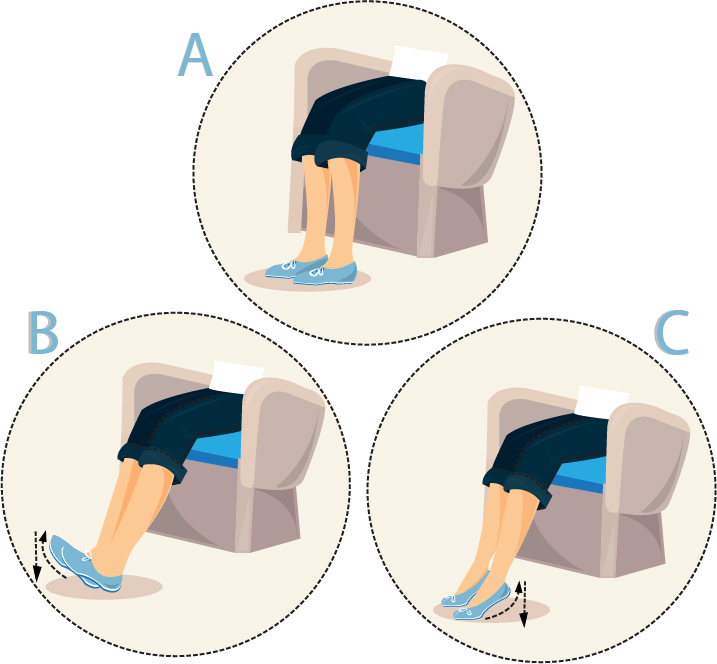
In general, moving as much as possible is recommended but even short durations of 10-15 seconds are better than nothing.  Even simple exercises performed while sitting can be quite helpful.  For example, you can raise your heels up and down while keeping your toes on the ground and then lift and lower your toes while keeping your heels down.  You can also tighten and relax the muscles in your legs and if space permits straighten and bend your knees.  The motion will limber you up and promote blood circulation to your tissues.  The improved blood flow also decreases your risk of developing a blood clot in your legs, known as a Deep Vein Thrombosis, which can occur due to prolonged sitting or inactivity and is a significant health concern.

Wearing loose fitting clothing to allow easy movement and staying well hydrated are other suggestions to minimize muscle aches and maximize comfort when travelling.  This article is for general information purposes only and is not to be taken as professional medical advice.