Monday, March 13, 2017

Preventing Falls

By Dr. John A. Papa, DC, FCCPOR(C)
 
A fall causing serious injury can occur to anyone at any time.  Since most trips, slips and falls happen in and around the home, it is a good idea to fall-proof your home with the following measures:
 
In the Halls and on the Stairs
·        Install non-slip strips on the edge of each step.
·        Secure loose carpet.  Make sure hallways and stairs are cleared of anything that you can trip over (i.e.books, shoes, bags).
·        Replace burnt-out light bulbs so that you always see where you are going.  Night-lights in halls and stairways can also be helpful.
·        Install handrails on both sides of staircases inside and outside the home.
 
In the Bathroom
·         Use non-slip mats inside and outside the bathtub and shower.
·         Install grab bars next to your toilet and in the tub or shower.
 
In the Kitchen
·         Put commonly used items on lower shelves and cabinets so a step-stool is not needed.
·         Replace loose scatter mats with rugs that have a rubber backing.
 
Outdoors
·        Keep a shovel and covered bucket of sand or salt near the doorway in winter to safely handle slippery conditions.
·         Keep steps and pathways clear of clutter such as yard tools, snow shovels, newspapers and wet leaves.
·        Don’t juggle parcels while trying to enter the house.  Never carry more than is reasonable.  Instead, make a few trips from the car with smaller packages.
 
More tips
·        Quickly dry up any wet areas on the floor to prevent slipping.
·        Wear shoes with good support and non-slip soles.
·        Always sit down to put on or take off shoes and clothes.
·        Employ extra caution when using ladders and step-stools.
·        Regular exercise can help improve your strength, balance and coordination.  Making your body stronger is one of the best ways to prevent falls.  Exercises such as yoga, Tai Chi, resistance training, bicycle riding, and power walking are great examples.
 
The following may be especially important for older individuals:
·        Maintaining a healthy diet and not skipping meals can increase your energy and strength.  Missing meals can lead to weakness, irritability and dizziness.
·        Have your MD or pharmacist review your medications.  Some medications can cause dizziness and weakness, which can affect your balance and perception.  Make sure that your MD or pharmacist explains all of the possible side effects of your medications.
 
Although the risk of falling increases as you get older, there are some simple things people of all ages can do to prevent falls.  In the event that you fall and suffer a muscle or joint injury that does not subside, you should contact a licensed health professional.  For more information, visit www.nhwc.ca.  The author credits the Canadian Chiropractic Association (CCA) in the preparation of this educational information for use by its members and the public.
 
This article is a basic summary for educational purposes only.  It is not intended, and should not be considered, as a replacement for consultation, diagnosis or treatment by a duly licensed health practitioner.

Monday, March 6, 2017

What Smoking Does To Your Musculoskeletal Health

By Dr. John A. Papa, DC, FCCPOR(C)
 
The musculoskeletal (MSK) system includes the muscles, tendons, joints, and bones of the body.  Cigarettes contain many harmful chemicals, including nicotine and carbon monoxide which negatively affect the physical health and integrity of the MSK system.  Included below is a summary of those affects:
 
1.   Smoking decreases bone mineral density (BMD) and increases the risk of osteoporosis and future fractures.  Studies have shown that nicotine reduces the blood supply to bones, slows the production of bone forming cells, and decreases the absorption of calcium.  Post-menopausal women who smoke have greater spinal osteoporosis than non-smoking counterparts.  Among men, a consistently lower BMD at all bony sites is observed regardless of when in their life they smoked.  In addition, a relationship between cigarette smoking and low BMD in adolescence and early adulthood has been identified.
 
2.    Smoking delays healing times for bony fractures and soft tissue injuries such as rotator cuff tears.  Nicotine has been shown to decrease the production of fibroblasts (the main cells responsible for tissue repair).  In addition, the carbon monoxide found in tobacco smoke reduces oxygen levels in the body which is critical for all tissue healing.
 
3.   Smoking contributes to an increase in spinal problems.  The reduced blood circulation found in smokers deprives spinal discs of vital nutrients which can lead to premature degeneration.  Smoking may also provoke disc herniation through coughing.  Studies demonstrate a definite link between smoking and low back pain that increases with the duration and frequency of the smoking.  Exposure to secondhand smoke during childhood may also increase the risk of developing neck and back problems later in life.
 
4.    Smoking increases pain levels.  Smokers complain more often of MSK pain than non-smokers.  Studies indicate that smoking makes individuals more susceptible to sensing pain at lower thresholds.  In addition, smoking causes general damage to the MSK system through direct chemical irritation, chronic inflammation, and restricting blood and nutrient flow.
 
5.    Smoking causes stress and de-conditioning in the body.  For optimal functioning, your muscles and joints need a steady supply of oxygen-rich blood.  Smoking not only stiffens your arteries, it also decreases the rate at which oxygen and carbon dioxide are exchanged in the blood.  Other side effects of smoking include fatigue, lung disorders, impaired healing, and chronic pain.  Impaired healing means that injuries affect you for longer than usual, and healing from surgeries or infections can be problematic.  These side effects can lead to inactivity, which causes deconditioning.
 
Scientific evidence has established links between cigarette smoking and its detrimental impact on the MSK system.  However, it is never too late to try and quit smoking.  Some of the negative health aspects of smoking start to reverse after a smoker quits.  Those looking for help in trying to quit should speak to a medical professional.  Valuable resources can also be found on the Health Canada and Canadian Lung Association websites.  For additional information on health and wellness, visit www.nhwc.ca.
 
This article is a basic summary for educational purposes only.  It is not intended, and should not be considered, as a replacement for consultation, diagnosis or treatment by a duly licensed health practitioner.

Friday, February 24, 2017

How To Choose The Right Pillow

By Dr. John A. Papa, DC, FCCPOR(C)

A good night’s sleep is important for maintaining good health and optimal functioning, and choosing the right pillow can make all the difference in the world when it comes to how well you sleep.  Using a pillow that is the wrong size and fit can be a significant source of neck and back pain.  In some cases, incorrect head and neck positioning can also affect breathing and cause snoring, which can hinder sleep.

The right pillow will help support the head, neck, and shoulders, keeping them in alignment, and thereby minimize stress and strain on muscles and joints.  As a result, this will also create a feeling of comfort and increase the likelihood of a restful sleep.

There is no one best pillow for everyone as there are a variety of factors that go into choosing the right pillow.  Below are some useful tips that can help you find the pillow that's right for you:

·         Consider your sleeping position.  Back sleepers should choose a pillow that is not too firm or too high.  The pillow should keep the chin in a natural resting position, and support the head and neck so they are aligned with the upper back and spine.  Side sleepers should opt for a firm pillow that supports the neck in a neutral position.  The pillow should hold the head high enough to ensure that the spine is aligned.  Stomach sleepers should choose a soft or flat pillow so the neck isn’t turned or tilted at an uncomfortable angle.

·        Choose a size of pillow suitable for your body size or frame.  The pillow should cover the entire back of the neck and mold to one's individual shape to alleviate any pressure points.

·        Try out a variety of pillows.  Most pillows are packaged in a plastic wrapper so you can lay it on a display bed in the store and put your head on it.  Visit a store that has a wide range of pillow options to find the one that best meets your needs.
 
·        A hypoallergenic pillow is a must if you suffer from allergies, but it is also a good choice for anyone.

·        Replace your pillow every 12-18 months.  Pillows will wear over time by losing their shape and ability to provide proper alignment and support.

If you experience pain and discomfort at night or have difficulty falling asleep, consider visiting a chiropractor.  Chiropractors are trained to treat muscle and joint problems that can interfere with a restful night's sleep.  They can also offer nutritional and lifestyle advice that can help improve sleep quality.  For more information, visit www.nhwc.ca.  The author credits the Alberta and Ontario Chiropractic Associations in the preparation of this educational information for use by its members and the public.

This article is a basic summary for educational purposes only.  It is not intended, and should not be considered, as a replacement for consultation, diagnosis or treatment by a duly licensed health practitioner.

Tuesday, February 21, 2017

Tips For New Mothers: Pre- And Postnatal Care

Canadian Chiropractic Association

Expecting a baby is very exciting, but it takes a lot of effort and attention to ensure both the mother and baby are healthy.  In this blog post we will outline some helpful tips for pre- and postnatal care. The information shared may help enhance or maintain your health during your pregnancy and delivery, and after the birth of the baby.

During the Prenatal Period1
Prenatal care is extremely important to ensure good health for you and your baby and decrease potential health risks during pregnancy. Being judicious about monitoring your health can help identify problems early, and allow opportunities for prevention. According to the Patient Education Institute, babies who are born to mothers who lack prenatal care have three times the chance of being born at a low birth weight, along with several other complications1.
 
Many of the following well-known preventative strategies are good to keep in mind to ensure mother and baby are healthy:
  • Stop smoking and limit your intake of alcohol
  • Talk to your doctor about any pre-existing medical conditions, dietary supplements (including folic acid), and any over-the-counter medications or prescription drugs you may be taking
  • Keep moving (consistent light exercise is important) and focus on healthy food choices
 

During the Postpartum Period2

Postpartum care starts after the baby is born and lasts about 6–8 weeks. During this time, the mother will focus on getting adequate rest, proper nutrition and other self-care measures as instructed by your family physician. Here are some helpful postpartum care tips:
 
Diet and Activities: After giving birth, it is recommended that a new mother continue to eat a balanced diet, drink plenty of fluids and slowly get back to normal activities and routines. For the first 2–6 weeks after a C-section, for example, she should refrain from physical exertion such as lifting, pushing and pulling of heavy objects. Ask your family physician or other healthcare providers if in doubt.
 
Postpartum Checkup: Normally, a healthcare provider will want to see the mother 6 weeks after delivery for a checkup. If there are complications, a visit may be scheduled sooner.
 
These are just a few things to consider, however, consulting with a healthcare provider such as a chiropractor is the best way to get proper information and care tips for your pre- and postnatal healthcare.
 
References:
1 Robin Madell, “Pregnancy Care.” Healthline. December 15, 2015. https://www.healthline.com/health/pregnancy-care#Overview1
2 X-Plain: Patient Education, “Postpartum Care.” The Patient Education Institute, Inc. Last reviewed August 23, 2012. https://www.kaahe.org/en/ArabicSampleModules/modules/obgyn/ogff01a1/ogff0101/ogff0101.pdf.

Monday, February 13, 2017

Managing Muscle & Joint Pain While Travelling

By Dr. R. Greg Lusk, DC

Along with the weather, winter get-away travel plans are a common topic of conversation this time of year while making small talk with clients.  Upcoming travel is also a driving force for some to have a painful complaint checked out as they are dreading the travel process ahead and are hopeful that the pain can be lessened so they can enjoy the vacation as originally planned.  Even for those that book an initial appointment a mere few days before departure, which doesn't allow much time for treatment to yield results, learning some key things to keep in mind or do while travelling can empower them to manage their symptoms independently.

Let's start with luggage as managing a heavy suitcase can be difficult even when you're not in pain.  Try to be restrictive in what you pack to lessen the overall weight and consider multiple bags versus a single large and heavy one if you cannot pack light.  Use wheels and pull handles if available.  Lift luggage with a straight back, bend at your hips and knees, and avoid twisting through the spine.  Lifting in stages can also help avoid excessive strain.  For example, when lifting a bag into an overhead bin, it can first be lifted to the top of the seat and then into the bin in a separate action. Similarly, loading a suitcase in or out of the trunk can be broken into steps, such that you lift the bag onto the bumper or edge of the trunk and then into the actual trunk.

Prolonged sitting, while either waiting in a terminal or in a mode of transportation (e.g. car, train, plane, etc.) is a reality of travelling that can lead to pain and stiffness throughout the body.  The seats often don't provide much support to the low back or neck so you may need to bring or create your own.  You could purchase a lumbar support cushion, use a bunched-up sweater, or roll up a blanket or towel to put in the small of your back.  With respect to your neck, using a travel pillow that fits around your neck will decrease your risk of discomfort while resting or sleeping in a seated position.  Hips and knees can also get quite stiff with extended time spent sitting, particularly in crammed airline seats where you cannot stretch out, and especially if you have pain or arthritis in those joints.  If possible, stand up regularly, every 30-60 minutes, to stretch out and walk around.

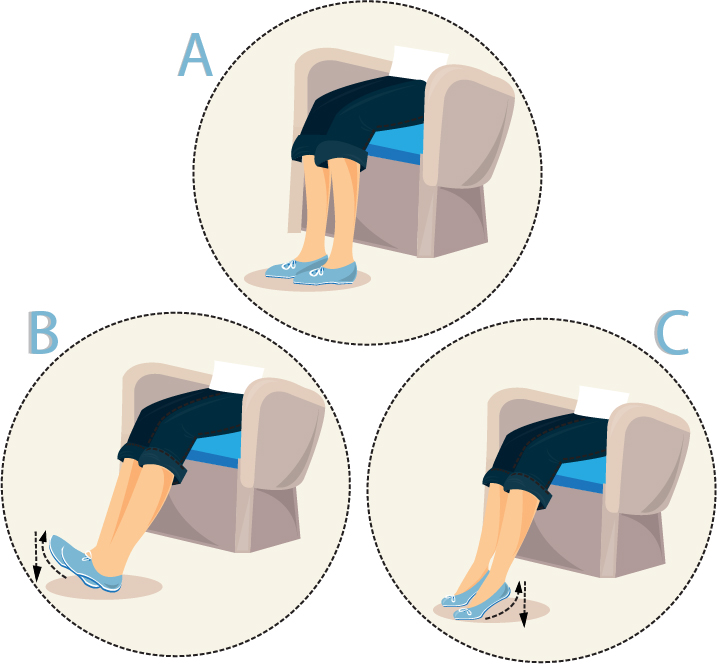
In general, moving as much as possible is recommended but even short durations of 10-15 seconds are better than nothing.  Even simple exercises performed while sitting can be quite helpful.  For example, you can raise your heels up and down while keeping your toes on the ground and then lift and lower your toes while keeping your heels down.  You can also tighten and relax the muscles in your legs and if space permits straighten and bend your knees.  The motion will limber you up and promote blood circulation to your tissues.  The improved blood flow also decreases your risk of developing a blood clot in your legs, known as a Deep Vein Thrombosis, which can occur due to prolonged sitting or inactivity and is a significant health concern.

Wearing loose fitting clothing to allow easy movement and staying well hydrated are other suggestions to minimize muscle aches and maximize comfort when travelling.  This article is for general information purposes only and is not to be taken as professional medical advice.

Tuesday, February 7, 2017

Understanding A Pinched Nerve In The Neck

By Dr. John A. Papa, DC, FCCPOR(C)

About two-thirds of people will experience neck pain at some point in their lives.  Occasionally, neck pain can spread to involve other structures such as the upper back, shoulder, and arm regions.  Pain in these regions is often dismissed simply as muscle pain.  However, a “pinched nerve” originating from the neck can radiate pain to these nearby anatomical sites and be a significant source of discomfort.

The “cervical spine” is the medical name given to the region of the neck.  Nerve roots originate from the cervical spine on each side.  These nerves send off various branches that travel to distinct regions in the upper back and arms to supply strength to muscles and provide sensation/feeling.  The term “pinched nerve” is often used to describe a mechanical and/or inflammatory irritation directly affecting any component of the nerve root(s) in the neck/cervical spine.

A “pinched nerve” in the neck can cause symptoms almost anywhere along the nerve pathway.  This may result in neck symptoms only, and/or symptoms that radiate into the chest, upper back, shoulder, arm, hand and finger regions.  The symptoms can vary widely and may include:  a cramping or achy feeling, tightness, burning or a sharp electric shock sensation, numbness, tingling, and arm muscle weakness.  The symptoms may start gradually and intensify over time.  Activities such as movement of the neck or shoulder, prolonged sitting or laying down, lifting, and even coughing or sneezing may aggravate the symptoms.

Below is a brief summary of three common causes of a "pinched nerve" in the neck:

1.     Spinal disc herniation/bulge – Spinal discs separate and cushion cervical vertebra.  Repetitive and cumulative loads or a heavy single load has the potential to cause a disc bulge or herniation, thereby causing a mechanical and/or inflammatory irritation of the nerve root(s).  This most commonly occurs in adults aged 20-50.

2.     Degeneration and Osteoarthritis – The normal aging process causes cervical disc degeneration and osteoarthritis of the cervical joints.  The consequence of these processes is that mechanical irritation from bony spurs on the vertebrae along with inflammation can cause irritation of the nerve root(s).  This most commonly occurs in adults over 50.

3.     Cervical spinal stenosis – This condition may cause “pinched nerve” symptoms due to narrowing of the spinal canal and/or nerve pathways, which puts pressure on the nerve root(s) or spinal cord.  This most commonly occurs in adults over 60.  It is usually secondary to degeneration and osteoarthritis.

Other causes of a “pinched nerve” in the neck include: direct irritation of nerve tissue by overlying muscles; direct trauma or injury to the nerve root(s); and mechanical changes in the neck associated with poor postural habits (i.e. head poking forward in the sitting position).  Some common causes of symptoms that act like a “pinched nerve” in the neck include muscular trigger points, ligament sprains and arthritic joints from the neck, upper back, and shoulder regions.

Treatment for a “pinched nerve” in the neck will often be different depending on the underlying cause of the symptoms.  Therefore, it is important to obtain an accurate diagnosis.  A proper medical history, along with physical examination consisting of range of motion, strength, neurological and orthopaedic testing, along with diagnostic imaging (if necessary) should be performed to aid in the diagnosis.  It is extremely important to rule out rare causes of “pinched nerve” symptoms such as spinal tumors, fractures and infections.  Disorders of the esophagus, trachea (windpipe), heart and thyroid can cause symptoms that overlap with those of a “pinched nerve” in the neck.  These potential causes require appropriate medical referral when applicable.

There are natural and conservative treatment options available for those suffering from a "pinched nerve" in the neck.  These may include: mechanical traction, spinal manipulation and mobilization, soft tissue techniques, acupuncture, ice/heat application, electrotherapy, activity modification, postural education, and rehabilitative exercise.  A qualified health professional can determine the cause of your symptoms and prescribe appropriate therapy and rehabilitation strategies specifically for your circumstance.  For more information, visit www.nhwc.ca.

This article is a basic summary for educational purposes only.  It is not intended, and should not be considered, as a replacement for consultation, diagnosis or treatment by a duly licensed health practitioner.

Friday, February 3, 2017

The Basic Characteristics Of Exercise

By Dr. John A. Papa, DC, FCCPOR(C)

Regular exercise has long been identified as an essential element of good health.  Below is a brief summary regarding some of the basic characteristics of a balanced exercise program.

·        Cardiovascular exercise improves the body’s capacity to deliver oxygen to working muscles and organs.  It is also a great way to help lose weight and control blood sugar levels.  Swimming, interval training, cycling, jogging, and power walking are a few examples.  It is recommended that an individual engage in a minimum of 15-30 minutes of cardiovascular exercise at least three times per week.

·        Resistance or strengthening exercise enhances a muscle’s ability to contract and do work.  Strengthening exercises can vary from using fitness machines, simple dumbbells at home, rubber bands, or your own body weight.  Improving or maintaining strength is important for preserving and building bone density.  This can assist in preventing osteoporosis and decrease the risk of fracture from falls.  Strengthening exercises can also boost metabolism and help keep a healthy body weight.

·        Flexibility exercise helps to maintain a joint’s complete range of motion.  Stretching is the most familiar form of this type of exercise but it can also include activities such as Tai Chi, Pilates, and Yoga.  Individuals with arthritic conditions can find this type of exercise extremely beneficial in helping them cope with stiff and painful joints.  This type of exercise can also prepare the body for physical activity to help minimize the risk of injury.

The exercise components of intensity, duration, and frequency will influence how one progresses through an exercise program.  For example, someone performing the cardiovascular portion of their exercise program of walking will find that after a short while they are able to walk quicker (intensity), longer (duration), and 5 days a week instead of 3 (frequency).  This same person also finds that they are progressing in their resistance program because they can now lift a heavier dumbbell (intensity), 10 times instead of 6 (duration), and 4 times a week instead of 2 (frequency).  A simple explanation for all of this is that your body is learning through exercise how to adapt to these positive stresses being placed upon it.  In order to keep progressing, the body must have a new stimulus placed on it every once in a while.  Of course there are limits to this, and sometimes switching the nature of the exercise you perform can be an adequate change in stimulus, resulting in continued health benefits from exercise.

A lifetime of regular cardiovascular, resistance, and flexibility exercise is ideal, but it is never too late to start!  If you are over 35, have been sedentary for some time, or have a specific health condition or limitation, consult with a knowledgeable health care provider before beginning any new exercise program.  For more information, visit www.nhwc.ca.

This article is a basic summary for educational purposes only.  It is not intended, and should not be considered, as a replacement for consultation, diagnosis or treatment by a duly licensed health practitioner.